

There’s an old joke about a plane flying from London to New York. Halfway across the ocean there’s a loud bang, and the pilot comes on. “Folks, we just lost an engine. Don’t worry, we can fly safely on three. We’ll be about an hour late.” The passengers grumble.
A while later there’s another bang. “Folks, we lost a second engine. We’ll still make it safely, but we’ll be two hours late.” More grumbling, and now some anger at the airline.
Then a third bang. “Folks, we’ve lost three engines. We can make it on one, but we’ll be four hours late.”
A passenger jumps up and yells, “Dammit, if that last engine goes out, we’ll be up here all night!”
He was worried about the wrong thing.
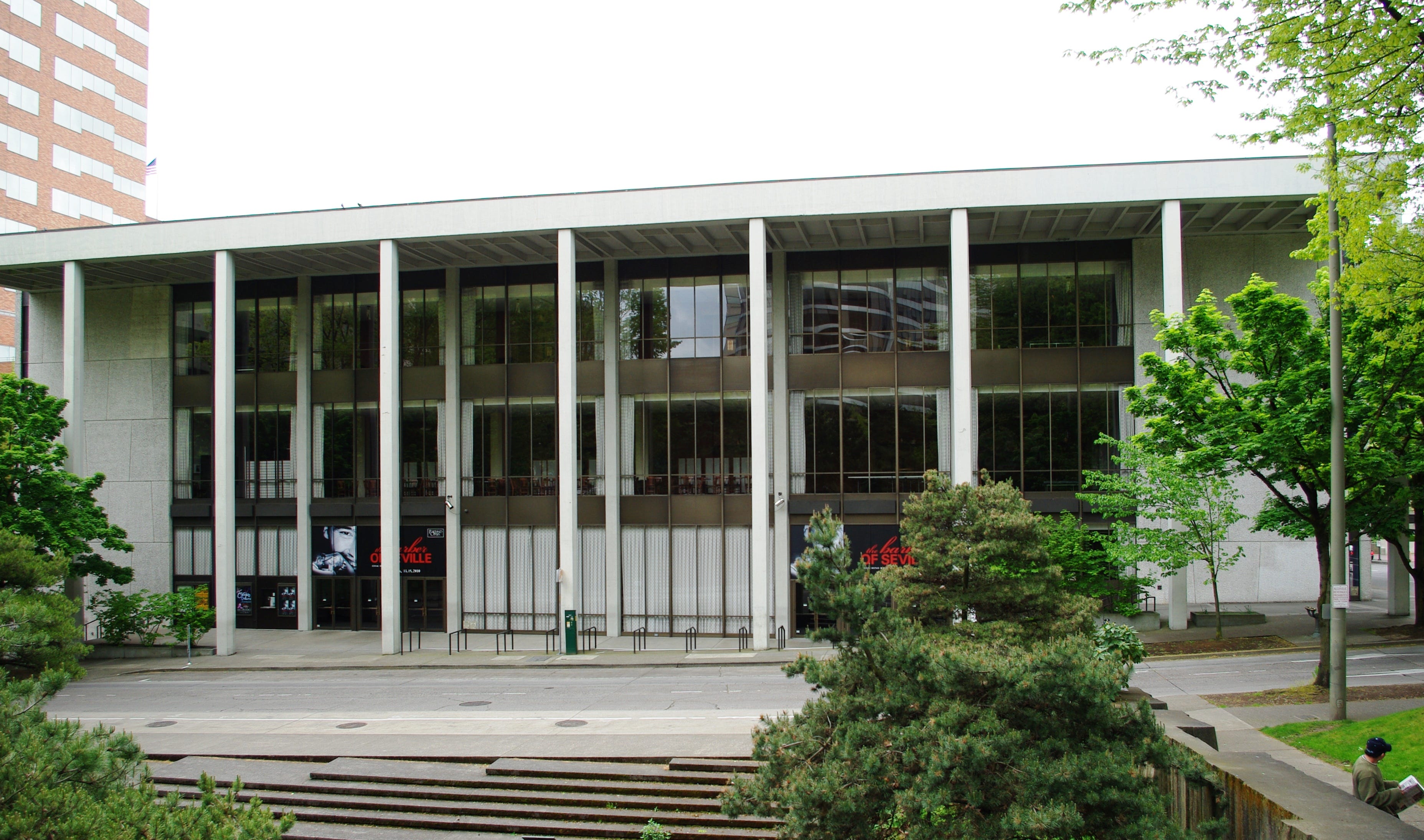
So is Portland. The argument is about buildings: renovate the Keller or build at PSU, and how long each will take. Those can wait. What can’t wait is who controls them. The City is deciding that right now, under rules nobody has written.
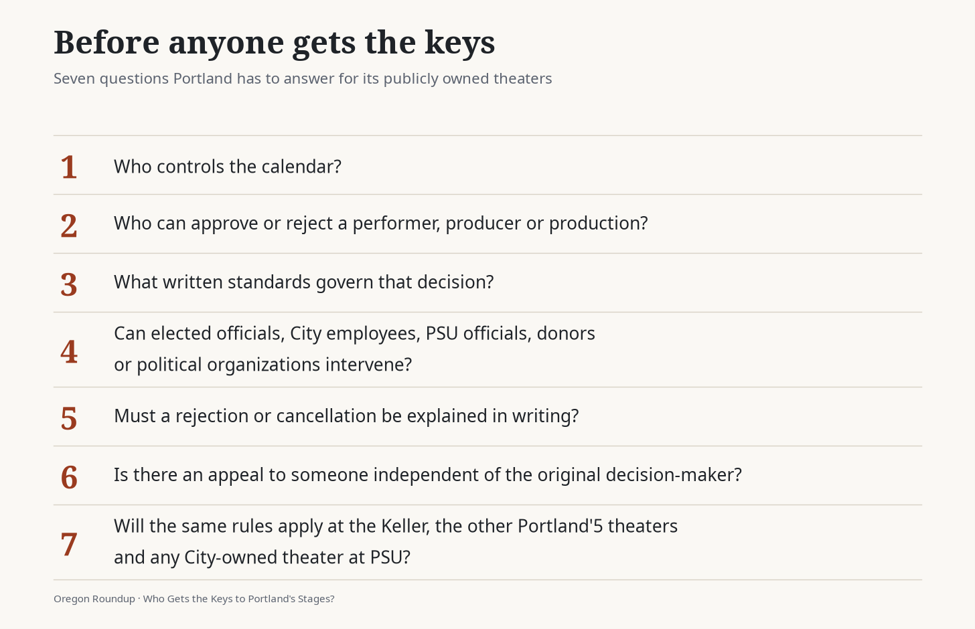
The rest of the column shows how we got to those seven questions. The answers are at the end.
Last week I argued that neither the Keller renovation nor the PSU theater is yet a project, and that Portland cannot responsibly choose between two announcements. Part one is here. This week I want to be clear about what kind of column this is. It is not a good-government column. Good government is merely the solution. The subject is survival.
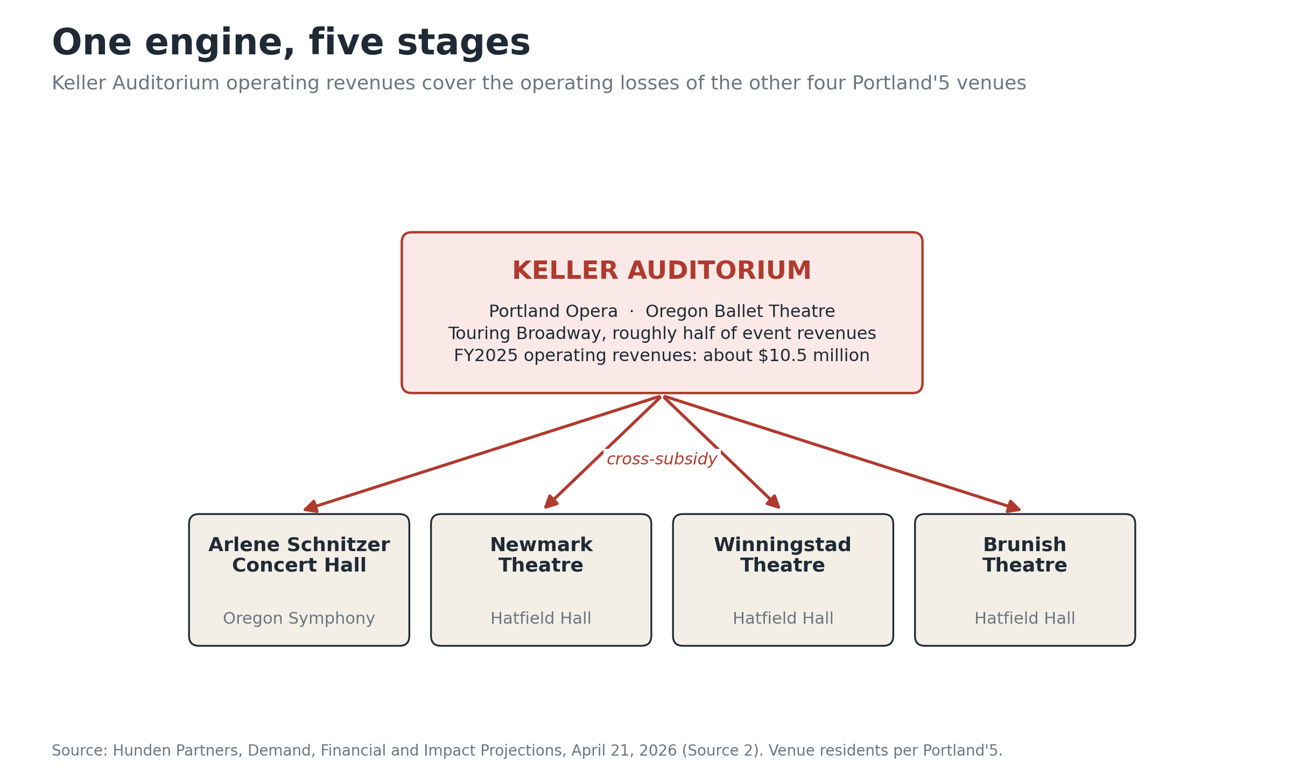
Here is what is at stake. The Keller Auditorium is the financial engine of Portland’s public arts infrastructure. It is where Portland Opera and Oregon Ballet Theatre perform and where touring Broadway lives, and Broadway is roughly half of its event revenues. In fiscal 2025 the Keller generated about $10.5 million in operating revenues, and that money covers the operating losses of the other four Portland’5 venues: the Arlene Schnitzer Concert Hall, home of the Oregon Symphony, and the three smaller stages inside Antoinette Hatfield Hall, the Newmark, the Winningstad and the Brunish. That is where the city’s mid-sized and small companies live: the children’s shows, the chamber dance, the recitals. Those are the rooms that will never fit 3,000 seats and were never meant to.
Politicize that engine, mismanage it, or split it from the system it funds, and the whole structure is exposed: the opera, the ballet, the symphony’s hall, the small stages, and the arts economy built around all of it. The Keller is the last engine.
You do not have to take my word for what politics does to an institution like that. The experiment has been run at full scale, on the grandest publicly chartered stage in America, and the results came in this month.
The Case Study
Until last year, the Kennedy Center was solvent, full, and above politics by long custom, its independence protected by nothing but that custom. In February 2025, the President dismissed the other party’s board members, installed himself as chairman, and removed the center’s president. The artists revolted, more than twenty cancellations and withdrawals, Hamilton among the first, and every artist who walked lowered the price of walking for the next one. By June, subscriptions were down 36 percent. By December, the building carried the President’s name, and within weeks the resident opera company had left the building entirely. On September 14, the center’s administration told its own board that the institution was on the brink of bankruptcy. The next day the board voted to close the building. Members of Congress and two lawsuits contend the cause is not the building. Nineteen months, takeover to closure, and the whole arc is in the chart below.
Note the direction this one came from, because it matters. The destruction of the Kennedy Center is being conducted from the right. In Portland, the prevailing political weather blows from the left. The cycle does not care. It runs wherever a stage’s independence is protected by custom instead of rule, and a tradition is a rule that stops existing the first time someone declines to follow it. The Kennedy Center had no charter. It had a habit.
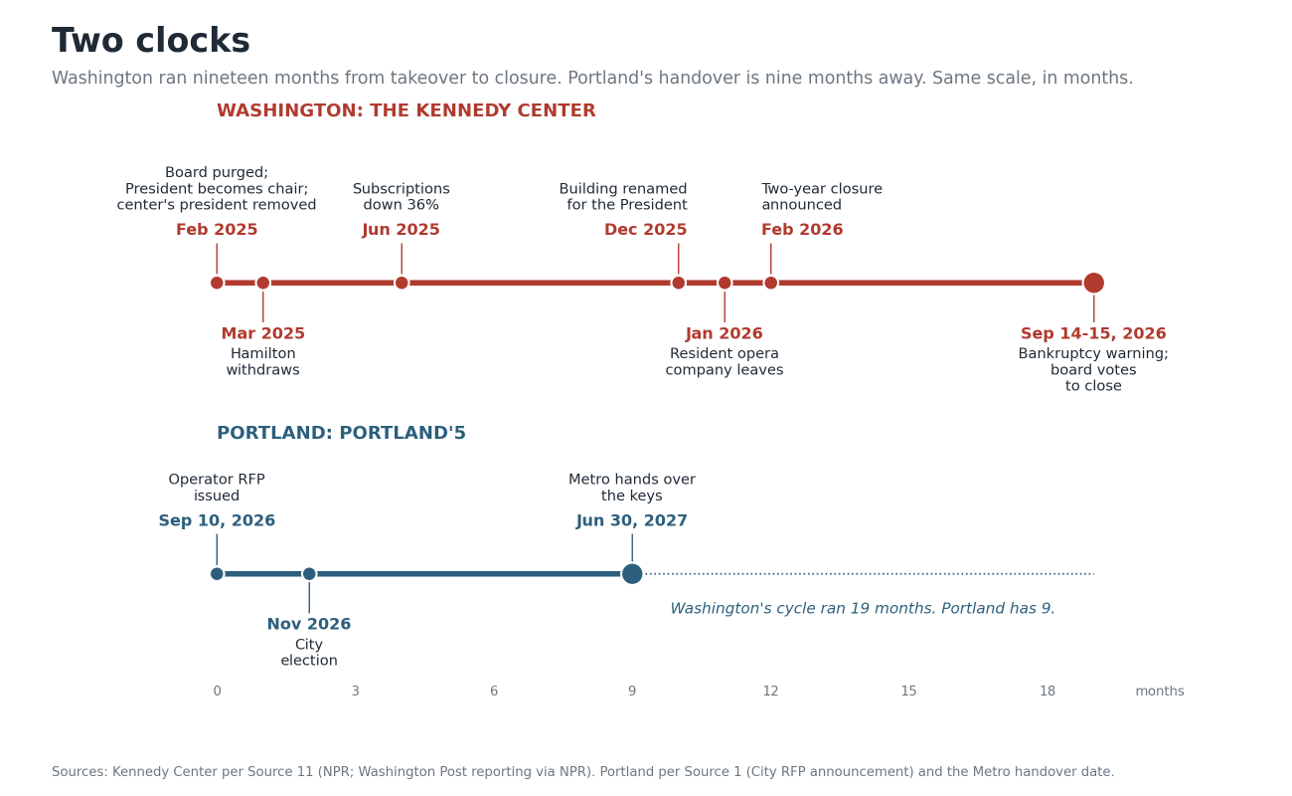
Portland’s own handover is nine months away, shorter than the Kennedy cycle takes to run. Here is what is being decided.
The Handover
On June 30, 2027, Metro, the Portland area’s elected regional government, stops managing the Portland’5 Centers for the Arts, a job it has held since 1989, and the keys to the City’s five theaters come home. The City has already begun soliciting a single private operator for the Keller and the other four venues; the request for proposals went out on September 10. The City’s operator announcement is here. At the same time, the City and PSU have been directed to negotiate a Project Commitment Agreement covering the scope, schedule and governance of the proposed PSU development. The PSU theater would be City-owned, but it is not part of Portland’5, its operator has not been selected, and its relationship to the other publicly owned theaters is unresolved.
Two documents will settle who controls Portland’s stages for decades: the operator agreement and the PSU governance agreement. Both are being written now. Neither is written yet.
Portland is hiring a doorman for its stages before it has written the house rules.
Remember the engine. If the Broadway programming moves to a City-owned theater at PSU under a different operator, Portland could end up with one operator responsible for the fixed costs of the existing five theaters and another controlling the programming that funds them. That is not a scheduling question. It is corporate governance and economic design.
Do not take that concern from me alone. The Steering Committee that recommended building at PSU told the City the same thing in its June 24 letter: to protect system-wide financial stability, write a formal operating agreement securing a dedicated funding stream from the PSU venue’s revenues to support Portland’5 and the broader arts sector. The people most enthusiastic about the new building agree that the linkage must be written down. It has not been.
And the risk yields the second demand, and this one has a name and a number: the Arts Keepwell Fund. In finance, a keepwell is a binding promise by a stronger party to keep a dependent one solvent, which is what the Keller’s earnings have quietly been for this family all along. Whatever Portland ultimately builds, the plan must do no harm to the system while it is being built. The development period will run years: design, financing, construction, the Metro handover, an operator transition, and, under either building option, seasons of disruption. Any plan the Council adopts should therefore carry an Arts Keepwell Fund on the order of $40 million, funded and ring-fenced before ground breaks, to keep the family of stages whole across that period. The number is not mystical. It is roughly the $8.5 to $17.5 million in critical Keller repairs Metro has already identified, which are due under any scenario, plus several years of the cross-subsidy that keeps the Schnitzer and the Hatfield Hall stages open if the engine sputters. Do no harm is the condition any physician, and any gaming regulator, imposes before authorizing surgery on a functioning system. A plan that cannot fund its own keepwell is not a plan. It is a bet made with the opera’s rent.
The Disputed Booking Is Already Here
The Kennedy Center is not an outlier. Here is the recent record, compressed. Every row is sourced at the end of this piece.
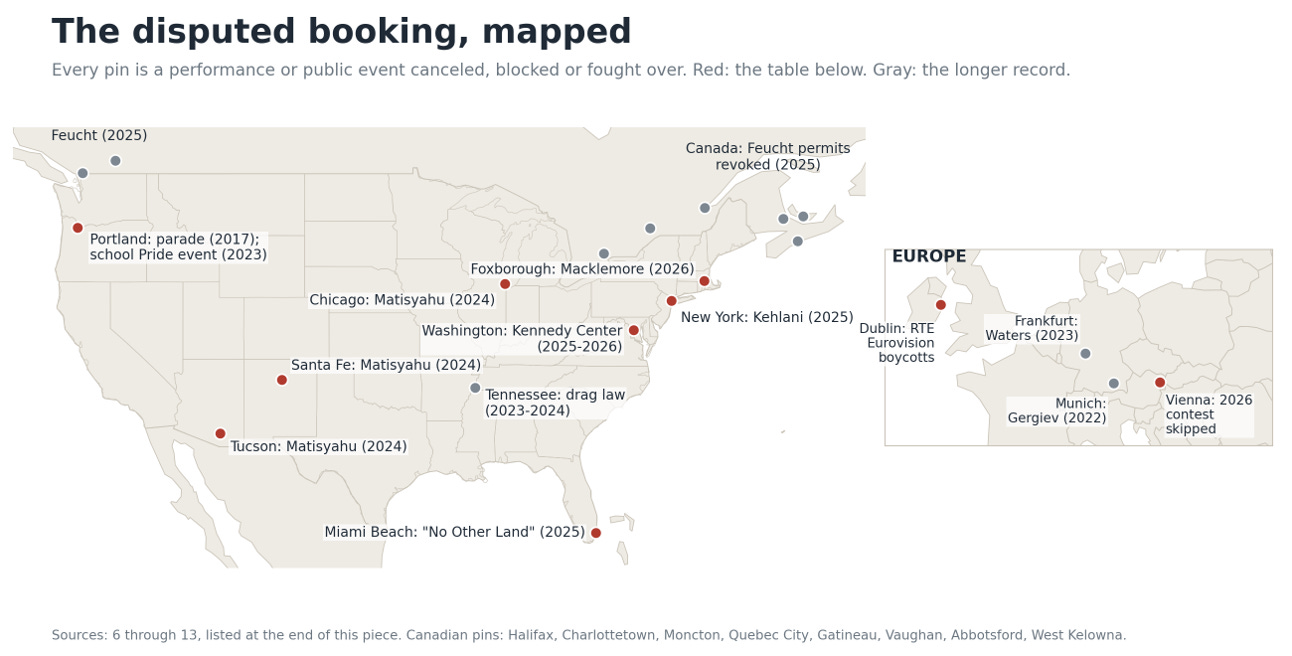
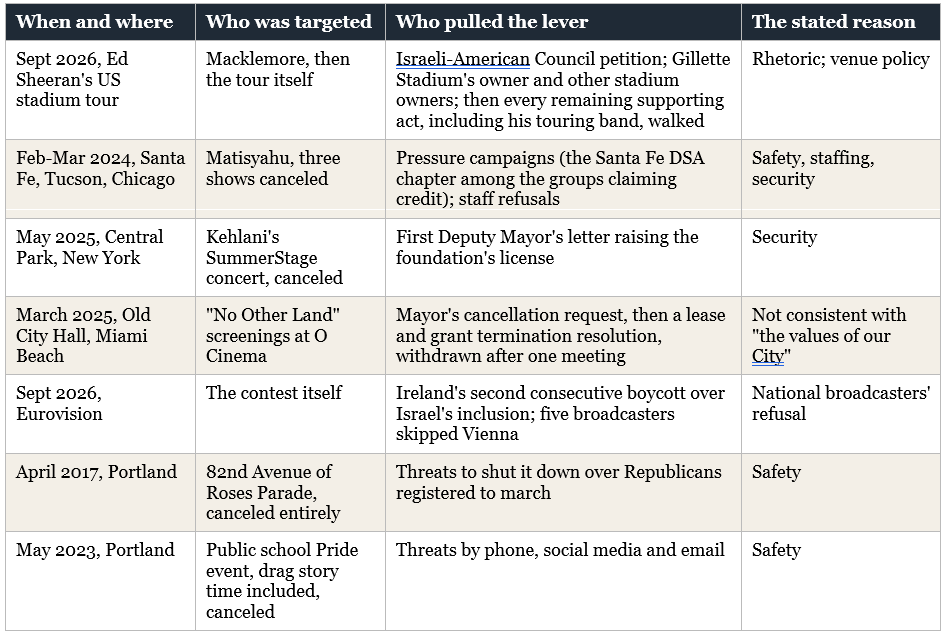
Read the last column again. Nobody ever says that we do not permit that viewpoint on our stage. They say safety, staffing, security, license conditions, values: the vocabulary of neutral operations, doing the work of viewpoint selection. And the lever pulls in both directions, officials one way in New York and Miami Beach, organizers the other in Santa Fe and on the Sheeran tour. In Multnomah County it has already come down from both sides and notice how the two local outcomes were produced: a parade died because Republicans were registered to march, and a school Pride event died after threats against its drag story time, by the same process. Whoever held the keys that day decided, under no published standard, with no written reasons and no appeal. Nobody’s side is safe. The only variable is who holds the lever in that town, that year.
And this table is a sample, not the census. The National Coalition Against Censorship now maintains a running map of American art censorship tied to Israel and Palestine since October 2023 because the incidents come too fast to track by hand, and the decade’s fuller record includes a city firing its chief conductor for refusing a political statement (Munich, 2022), a state law restricting drag performances, ruled unconstitutional by a trial judge and then reinstated on appeal (Tennessee, 2023-2024), and government permits revoked on a touring Christian worship singer citing public safety (multiple Canadian cities, 2025).
Portland is about to build that lever and hand it to an operator, with the rules unwritten.
Broad Grants of Discretion
The City’s operator solicitation says the successful Portland’5 operator must work “in alignment with the City’s Core Values and goals.” It must also balance commercial activity, community representation and local partnerships. Those phrases may reflect admirable intentions. They are also broad grants of discretion. And recall which word did the work in Miami Beach: the mayor’s letter asked the cinema to cancel a film inconsistent with the city’s values. Values is not a standard. It is a blank check with a respectable signature.
And the discretion is not being handed out into calm weather. Political litmus tests are now ordinary equipment across the spectrum. Washington just demonstrated the right’s version at institutional scale, and Portland’s civic culture, like most cities’ now, has published versions of its own. I am not interested in prosecuting any faction for its tests. A private association may set whatever terms it likes for its members and its endorsements, just as it was Gillette Stadium’s right to bar a rapper. The point is the instrument, and the modern instrument is the negative endorsement: a test that asks not what you support, but whose support disqualifies you. A booking veto is a negative endorsement applied to a stage, and whoever holds the keys can run one without ever writing it down.
So, build the protection the way workplaces learned to build theirs. Every functioning workplace has boundaries on actions and speech, and the good ones work: they do not audit anyone’s politics, they govern conduct, and inside those boundaries people who agree on nothing do great things together every day. A public stage needs the venue version of that. Not total license; a theater is not obliged to host what is unsafe, unlawful or commercially impossible. Rules that govern conduct and operations while protecting the expression of artistic intent, for the audiences who seek that experience, whoever they are and whatever they believe.
One more reason to write those rules now, rather than trusting whoever currently seems trustworthy: Portland votes again this fall, and majorities change. That is the only prediction in this piece.
Before granting that discretion, Portland should define its limits.
Seven Questions Before Anyone Gets the Keys
I do not think Portland needs another blue-ribbon committee to write a philosophical declaration about the importance of art. It needs answers to the seven practical questions at the top of this column.
Those questions determine whether a producer can bring a show to Portland, whether an arts organization can obtain a date, whether a controversial performer can rent a publicly owned stage and whether political influence can quietly override ordinary commercial standards.
I have expressed concern that acts falling outside Portland’s prevailing progressive culture could eventually be disfavored. I want to be exact about what I am and am not saying.
I have not found evidence that Portland currently maintains a political blacklist of performers. I am not accusing anyone of operating one.
I am saying that a publicly owned cultural system should not rely upon the goodwill of whoever happens to control it. Portland’s political divisions are real. Cultural majorities change. A discretionary power welcomed when exercised by people we trust becomes much less attractive when the other side acquires it.
This is not a theoretical concern invented for Portland. In Southeastern Promotions v. Conrad, a municipal board refused to make a public theater available for a production of Hair. The United States Supreme Court held that the system operated as an unconstitutional prior restraint because it gave officials discretion without adequate procedural safeguards. The decision does not give every producer a right to every public stage. It demonstrates why access to a publicly owned theater should not depend upon vague standards and unreviewable official judgment. The Supreme Court decision is available here. The lesson has not aged. In 2023, officials in Frankfurt tried to cancel a Roger Waters concert at the publicly owned Festhalle over the content of his politics, and a court ordered the show to proceed. When the rules for a public stage are not written in advance, a judge ends up writing them afterward, at everyone’s expense.
That is why governance is established before the disputed booking, not after it.
The Bill of Artistry
Before the City selects an operator or completes the PSU governance agreement, the Mayor and Council should adopt a short, binding Bill of Artistry: a bill of community art that answers the seven questions at the top of this column, in order, for every City-owned performing-arts venue.
1. The calendar belongs to the professionals. Ordinary booking and programming decisions are made by the venue’s operator, with professional independence.
2. Approval and rejection run on published standards: viewpoint-neutral criteria covering availability, technical suitability, financial terms, safety and lawful conduct, posted where any producer can read them before applying.
3. Nobody intervenes. No elected official, City or PSU employee, donor or political organization holds a veto over an individual lawful production, and no producer, performer or audience faces a discrimination or loyalty test.
4. Every no comes in writing, with reasons.
5. Every no can be appealed, promptly, to a decision-maker independent of the first one.
6. The record is public: bookings, denials, cancellations and the standards applied, with legitimate confidential information protected.
7. One family, one rulebook. The same rules and the same contract and cancellation terms follow every City-owned stage, the Keller, the Schnitzer, the Hatfield Hall theaters and any future venue at PSU, whichever bureau, university, nonprofit or private company holds the keys.
The City should retain financial oversight, audit rights, safety requirements and enforcement of contracts. It should not become Portland’s theatrical censor or ideological booking agent.
These protections would not prevent an operator from exercising professional judgment. A theater cannot accept every production. Dates conflict. Some shows cannot cover their costs. Others may not fit the stage, satisfy technical requirements or provide adequate security. Those are legitimate operating judgments.
The purpose of governance is to distinguish those judgments from political preference and to make the people exercising public power accountable for how they use it.
The City should also decide whether the Keller, the other Portland’5 venues and a future PSU theater will operate as one coordinated system. Two publicly supported operators should not be allowed to compete for the same productions, donors and subsidies without a deliberate public decision establishing why that arrangement benefits Portland.
Not Just Portland
This is not a Portland peculiarity. Every Oregon city that owns a stage, an arena or a fairgrounds hall, or that contracts a private operator to run one, has the same unwritten house rules problem. The defect is structural: public ownership, discretionary control, no published standards, no appeal. Portland’s version simply has a deadline attached. Any city in the state that adopts these rules before its own disputed booking arrives will be glad it did.
Decide the Rules While the Money Is Imaginary
The construction decisions are years and hundreds of millions of dollars away. The governance decisions are months away, and they cost almost nothing.
Portland is choosing a new Portland’5 operator now. It is negotiating the PSU governance framework now. Decisions made in those two processes may determine who controls Portland’s stages for decades, long after every official currently in office is gone, and long after today’s cultural majority has become some other majority.
So, before Portland decides where to put its next great theater, it should decide who gets the keys, who writes the house rules and what happens when someone tries to use public power to decide which voices Portland is permitted to hear.
So here is the call to action, and it fits on an index card. The community should demand two things, together, because each is weak without the other.
The Bill of Artistry: adopted by Council resolution before the operator is selected and before the PSU agreement is signed. It requires no bond, no tax, no capital stack and no consultant. It is the rare item in this saga that is fully funded on arrival.
The Arts Keepwell Fund: no development plan reaches a final vote without the $40 million funded inside it, because a city that cannot keep its arts family whole through construction has no business promising it a new building.
The rules and the reserve. Write down who gets the keys and protect the house while it is being rebuilt.
One more thing the record teaches. The private cancellations, the stadiums, the tour venues, the clubs, were private owners exercising private discretion, which is their legal right and will remain so, including at the two large private venues opening in Portland next year. But the most instructive cases happened on public property. Central Park, where a license letter and the word security canceled a concert. Miami Beach’s Old City Hall, where a lease and the word values came within one commission meeting of closing a theater. That is what unwritten discretion does on public ground: it waits for someone to use it. The Keller belongs to every taxpayer in Portland, the fan of the pro-Palestinian rapper and the fan of the Zionist reggae singer alike. A publicly owned stage is the one room in town where the law can guarantee that nobody checks your politics at the door. But the guarantee does not write itself. New York did not write it. Miami Beach did not write it. Washington never wrote it, ran nineteen months on habit instead, and is measuring the cost in a shuttered hall. Portland can be the city that writes it before the letter arrives.
That is an outcome nobody on any side of this culture war should want to prevent. It is also entirely achievable, this year, for free.
Sources
1. Portland’5 venue operator request for proposals, City announcement, September 10, 2026. portland.gov
2. Demand, Financial and Impact Projections, Hunden Partners, April 21, 2026 (Broadway share of Keller event revenues; FY25 operating revenues and cross-subsidy of other Portland’5 venues). portland.gov
3. Future of Large-Scale Performing Arts Steering Committee recommendation letter, June 24, 2026 (formal City-PSU operating agreement with dedicated funding stream for Portland’5). portland.gov
4. Resolution 37752 council committee summary, September 2026 (Project Commitment Agreement direction; PSU venue not part of Portland’5). portland.gov
5. Southeastern Promotions, Ltd. v. Conrad, 420 U.S. 546 (1975). law.cornell.edu
6. Macklemore removed from Ed Sheeran’s US tour after Robert Kraft and other stadium owners refused to host him; Israeli-American Council petition (Action News Jax/Cox wire, Sept 14, 2026; NewsChannel 9, Sept 2026). All four supporting acts, including touring band Beoga, withdraw (AP via Boston.com, Sept 15, 2026). actionnewsjax.com · newschannel9.com · boston.com
7. Matisyahu: Meow Wolf (Santa Fe) cancellation and joint statement claiming credit, including Santa Fe DSA (Santa Fe Reporter, Feb 2024); third cancellation, House of Blues Chicago, March 2024 (JTA). sfreporter.com · jta.org
8. Kehlani SummerStage cancellation after First Deputy Mayor Randy Mastro’s May 5, 2025, letter citing security and the City Parks Foundation’s license (Rolling Stone, May 2025). rollingstone.com
9. Miami Beach: Mayor Meiner’s March 5, 2025, letter calling “No Other Land” inconsistent with “the values of our City and residents” (International Documentary Association); lease and grant termination resolution withdrawn March 19, 2025 (AP via ABC News). documentary.org · abcnews.go.com
10. RTE confirms second consecutive Eurovision boycott; Ireland one of five broadcasters that skipped the 2026 contest (Reuters, Sept 17, 2026). cyprus-mail.com (Reuters)
11. Kennedy Center: artist cancellations since the February 2025 takeover, Hamilton among the first (NPR running list, Jan 20, 2026, updated March 2026); bankruptcy warning to the board (NPR, Sept 14, 2026); board votes to close the building (NPR, Sept 15, 2026). Subscription decline and opera departure per NPR and Washington Post reporting. NPR list via KPBS · npr.org Sept 14 · npr.org Sept 15
12. Multnomah County record: 82nd Avenue of Roses Parade canceled after threats over Republican participation (Willamette Week, April 25, 2017); Atkinson Elementary Pride event canceled after threats (KATU, May 2023). wweek.com · KATU via komonews.com
13. The longer record: NCAC Art Censorship Index: Post-October 7th ncac.org; Munich dismisses Valery Gergiev, March 1, 2022 gramophone.co.uk; Tennessee drag law reinstated on appeal, July 2024, Supreme Court declines review, Feb 2025 wpln.org · advocate.com; Sean Feucht permits revoked citing public safety, July 2025 globalnews.ca; Frankfurt court orders Roger Waters concert at the Festhalle to proceed, April 2023 loudersound.com
AI disclosure: The author used generative AI (Claude, from Anthropic) to assist with organization, drafting and source-finding, and to build the graphics from public records and published news reports. The reporting framework, analysis and conclusions are the author’s, and all factual claims were checked against the cited source materials.

The best local case study for this column is not in Washington. It's the Regional Arts & Culture Council, and Richard Cheverton of Portland Dissent has documented it for years, mostly alone.
RACC was the nonprofit contractor that distributed Arts Tax money after the schools took their share. Cheverton reported, citing the Mercury, that for a decade most of RACC's grant dollars went to the city's five largest arts institutions: the Art Museum, the Symphony, Oregon Ballet Theatre, Portland Opera, and Portland Center Stage. In 2019 RACC adopted a new framework that weighted each applicant's commitment to "underrepresented communities" in its programming, staffing, and mission. By the 2022 award list, he found, none of the five appeared. [1] The opera, ballet, and symphony this column is trying to protect were written out of the city's arts grant program in about three years.
Nobody said "we don't fund opera." They said equity. That is precisely this column's point about the vocabulary of neutral operations doing the work of viewpoint selection. And notice the word that keeps recurring. Cheverton reported, citing the Tribune, that in 2020 RACC adopted a policy allowing removal of public art whose subject or impact was "at odds with values of antiracism, equity, inclusion," and that its board discussed the policy in closed session. [1] The operator RFP asks for alignment with "the City's Core Values." RACC shows what that phrase can authorize. As Cheverton also documented, RACC asked applicants demographic questions and published recipients' demographics as an accomplishment. [2] [3]
The accountability shield is the part that should worry anyone drafting the operator agreement. Cheverton asked RACC how grant applications were judged, who the reviewers were, and what metrics measured results. He was told the applications were not public, that the reviewers' rationales were a closed process, and that what RACC could offer was the published award list and data on the demographics of applicants and recipients. [1] When he asked again in 2025, he got what he called a carbon copy of the same answer. [3]
In 2023 I separately asked RACC whether grantees' final reports to the RACC about their grants were available and, if not, on what legal basis. Its Chief of External Operations replied in writing that RACC is not subject to public records requests because it is not a government entity. She said it owed the public only its 990 and its audit, and that it would not release what I asked for. [4] Measured against the Bill of Artistry, that means no published standards, no written reasons, no appeal, and no public record. All of it was legal, because public money passed through a private corporation, which is the same structure as the operator Portland is now hiring.
Nor did the City's attempts to rein RACC in amount to anything durable. As Cheverton recounts, a 2018 City audit faulted RACC's financial transparency; in December 2022 the Council declined to accept its annual report, reportedly for the first time in 28 years; and in 2023 the City cut its funding and announced it would not renew the contract. [3] Then came the rebid, and RACC walked away with the largest share, $1.2 million. Every step was discretionary, and none of it changed how RACC makes decisions or what it must disclose. Oversight by political mood is no more durable than independence by custom.
Three lessons for the Bill:
1) A litmus test doesn't have to be secret. It can be adopted openly as a mission statement and still work as a viewpoint filter. Item 3 should expressly bar weighting decisions by applicants' identity or by their alignment with City "values."
2) Item 7 must reach any nonprofit intermediary, not just operators of buildings.
3) Public-records access belongs in the operator contract itself. A private operator will otherwise make RACC's argument, and it will win.
The Kennedy Center took nineteen months. RACC took about three years, and nobody called it a takeover. They called it reform.
[1] "I Paid $35 and All I Got Was Some Lousy Art." 2 March 2023. https://portlanddissent.substack.com/p/i-paid-35-and-all-i-got-was-some?utm_source=publication-search
[2] "I Wanna Be an Artist!!!" 12 June 2023. https://portlanddissent.substack.com/p/i-wanna-be-an-artist?utm_source=publication-search
[3] "A Nonprofit Solves the Secret of Eternal Life." 9 April 2025. https://portlanddissent.substack.com/p/a-nonprofit-solves-the-secret-of?utm_source=publication-search
[4] Personal communication. 29 March 2023.
Excellent article, clear goals that should be codified but Portland ( Oregon, Multco, PPS') SOP is Ready Fire Aim or even Fire Aim Ready. Another concern is the propensity of the City to tolerate certain groups that take it upon themselves to publicly and violently obstruct anyone or anything they deem unacceptable. That and the fact the city appears broke suggests this is going to be a long process