
Portland faces important decisions on its two primary indoor venues
The Rose Garden and Keller Auditorium need expensive renovations and there might be more at stake than you think

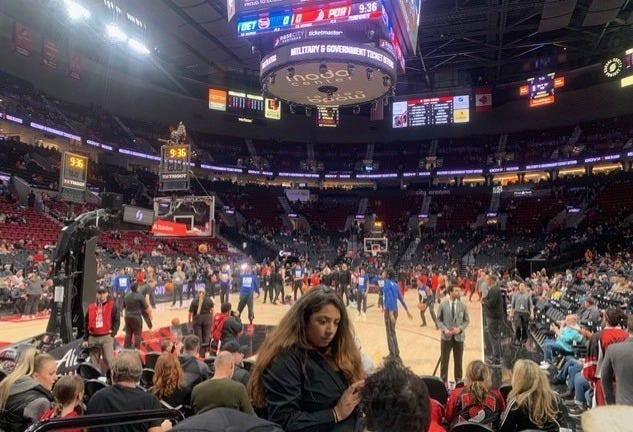
Regardless of your entertainment tastes, if you watch large-scale performances in the Portland area you probably attend events at Moda Center and/or Keller Auditorium. If you want to continue to attend those events, you should tune in to ongoing negotiations involving both facilities.
There are significant differences in the specifics of the negotiations involving the two public venues. But the same controversial question looms over the future of both facilities: To what extent should the public subsidize entertainment venues that generate significant profits for entertainers, athletes and related businesses?
It’s a good question and there are no easy answers. I won’t offer a definitive recommendation, but I do hope to encourage a deeper discussion. My foundational principles for discussion of the future of the two venues:
Your view of any proposal should not rest primarily on the extent to which you enjoy attending events at the facilities.
Both facilities provide community value, even to those who never attend events.
Before going forward, let’s briefly look at the specific issues and proposals involving both facilities:
Moda Center
Moda Center is known primarily as the home for the Portland Trail Blazers NBA franchise and starting this summer the city’s new WNBA team. But it also is the only indoor venue in the metro area that can handle an event of more than about 5,000 people. It opened in 1995 and has not had significant renovations since opening. It is one of the oldest NBA arenas and one of few older arenas that has not undergone a major update.
Originally, former team owner Paul Allen owned the arena, but the city of Portland acquired it after he died. Paul Allen’s estate is in the process of selling the Trail Blazers to a group led by Tom Dundon, a Dallas investor and entrepreneur who also owns the Carolina Hurricanes NHL franchise. The Trail Blazers are under lease to play at Moda Center four more years, but the pending sale of the franchise has led to discussions about whether Dundon might move the franchise if the arena is not renovated or replaced.
The Legislature recently approved its $365 million portion of a proposed package to renovate the arena. Portland Mayor Keith Wilson has voiced support for the city’s participation. Multnomah County, as often is the case, has sent mixed messages. Altogether, the three governments would raise $600 million through bonds financed by taxes assessed on players and other funds.
Keller Auditorium
Keller Auditorium is Portland’s primary venue for touring theater promotions. It also hosts concerts, ballet, opera and the occasional comedy show. Keller is even older than Moda, originally built in 1917 as Portland Public Auditorium and extensively renovated in 1968.
Keller is owned by the City of Portland and managed by the Metropolitan Exposition Recreation Commission, a unit of the Metro regional government that also oversees four other public arts venues. Perhaps the biggest difference in the debate over its future and the debate over Moda is that there’s no question about who is responsible for its future. Taxpayers can’t hope that a private owner will take care of it, though there have been proposals for competing private event venues and there is a vigorous debate over how to manage the five public venues.
In part because there is no ownership change nor anchor tenant forcing a discussion, the planning for Keller’s future is not as far along as plans for Moda. But the two facilities should be discussed in tandem, both because of their similar roles in the community and the potential combined cost to taxpayers.
Advocates for sports and arts venues point to various studies about facilities’ importance to communities. Opponents reference a different set of studies with opposite conclusions. All the studies rest on enough assumptions to leave room for healthy debate.
Many of the arguments for and against public funding of arts and sports venues are the same:
First, the strongest arguments for:
They contribute to the “livability” of a community. That argument is particularly important to a city like Portland that has long marketed itself based more on livability than economic viability.
They are among the city’s most visible buildings and as such are an important part of both the city’s architectural footprint and image. For an example of this, note that the Trail Blazers’ former home, Veterans Memorial Coliseum, still stands more because of the advocacy of the architectural community than because of its value as a sports and arts venue.
Now, the most common arguments against:
There’s a strong theoretical/ideological argument against government support of professional sports and profit-producing arts. These are not essential functions of government, especially in a city and state with many pressing problems.
Though Moda and Keller are outdated, they still are functional.
Those who argue for one venue and against the other likely are just making a case for the form of entertainment they like more. But the consequences of inaction are similar.
Losing its NBA team or access to Broadway plays because the city wouldn’t invest in updated facilities would bring more negative national attention to Portland at a time the city’s image already is badly tarnished.
The last metro area to lose its only major-league sports franchise was Syracuse in 1963. Oakland has lost three teams in the past seven years, but the NBA Warriors moved across the Bay to San Francisco and still are accessible to the team’s fans. The Bay Area also still has teams in every professional sports league. The Portland area would have professional men’s and women’s soccer teams and Single A minor league baseball if the Trail Blazers moved. It’s unknown whether an unrenovated Moda Center would be adequate to keep the WNBA Fire.
Some argue the possibility of the Blazers moving is more threat than reality. They are counting on the NBA to block a move, and it’s true the NBA doesn’t like for franchises to move. But the league does allow it, something our neighbors in Seattle remember well as they watch their former team win NBA titles in Oklahoma City.
As to Keller Auditorium, failure to update the facility likely would lead to a slow erosion of events and would be much less noticeable, barring an earthquake to expose the facility’s seismic flaws. But arts facilities are part of a city’s image. There’s no city close to Portland’s size without an adequate facility for touring Broadway plays and most have facilities that are newer or were more recently updated.
Beyond the decline in livability and blow to the city’s reputation, failure to secure the future of professional sports and high-end performing arts also would come with financial costs. The city of Portland still would own both Moda Center and Keller Auditorium.
How would the facilities generate revenue without tenants or with reduced bookings? Renovations are costly, but so is inaction. It’s also important to realize almost all cities subsidize these activities in one way or another. If Dundon announced he wanted to move the Blazers, and the NBA signaled a willingness to approve a move, at least some cities without teams would offer subsidies bigger than those being discussed in Portland.
So, what should Portland do. In a departure from my usual columns, I’m not making a recommendation, though I have a preference. That’s because I think it’s possible to make a rational argument in either direction. What I would discourage anyone from doing, though, is opposing funding and thinking that decision won’t lead to the loss of the Trail Blazers and a reduction in arts options.
Portland long has marketed itself on livability. Professional sports and high-end arts are as much a part of livability as access to mountains and the ocean. We can’t market the city based on the economy, and we have to promote something beyond it’s a great place to be woke.
Bottom line: There’s a cost to be paid either way. Leaders must decide which one ultimately is most costly.
 | A guest post by
|
The City’s image is tarnished because the City is failing. It’s failing because of its silly progressive government. We have city and county spending in Portland that is well above the national average for cities — several thousand per person above average. There is plenty of money if it were spent wisely. But our government and voters don’t want that. They want a failed city. I want to keep the Blazers and arts at the Keller or a replacement. But the Blazers are a bad team partly because of the owner and partly because of the heavy tax burden here, highest in the nation. Good free agents don’t want to come here. It’s a tough question with no commitment by the voters or the government to search wisely for a solution. Read the Oregonian today and you will see why. Another housing project is stalled. There is little actual good news.
I find it difficult to believe that a physical facility barely 30 years old must be replaced. What is wrong with it and why is it obsolete after only 31 years? As far as Keller goes, is the structure itself in danger of collapsing? This obsession with "NEW" and "MODERN" needs to be exhaustively questioned. We have already become a throwaway society, rife with waste and shoddy construction. This needs to change.